This chord is called "The Chord of Love" because it evokes a feeling of longing. The Seventh on top of the chord, in this case a C, is one semitone below the Root of the chord, a C#, which creates a sharp dissonance - an endless suspended resolution like love. This album is chock full of Major Seventh chords.
At :40, the field rhythms enter. A rustling walk down a leafy path eventually halts as a light rain picks up the beat. At 7:16, the C# Major 7th gives way to the 2nd chord of the track, a B-flat major that also features a lot Major 7th movement.
It is a less stable chord than the first, as it is constantly inverting itself when new tones fade in and old tones fade out, and might more accurately be described as a progression. The strongest melody is found in the whole tone swells from G to F, pictured above, on the right hand side of the score. There's definitely an E-flat in there, which would turn the chord into an Eb Major Seventh. Either way, this part is in the key of Bb Major. The lowest note you hear in the example above, is a Bb.
At 12:15, the music leaves. For a brief chordless interim, human voices are heard, as well as distant birdsong, till the final chord of track one swells in to play. This time, it's in the key of B Major, one semitone above a Bb.
To express some of the ambiguity of the previous example, the chord below is shown as an E major Seventh even though the key sounds like B major because of the underlying B Root.
Track 2, "Indentions on Summits of Hands" has two distinct chordal sections. The first one begins with a B Major to Bb Minor movement. These two chords are in the key of F# Major. This is by far the strongest chord progression on the album and often features 7ths on both chords.
At 6:00, the progression dies down, leaving a sustained high B note. A G# occasionally peaks up underneath creating a Minor. The track finishes out with some more foot rustling and metallic jiggles.
Track 3, "Tended Pouring" closes out the album with two more chords. The first chord is very similar to the C# Major featured in Example 1, and the final chord is an E Major 7th, like Example 3. My main gripe with this album is the rush of white noise found at 11:20.
One of the softer colors of noise might have been more suitable. Like pink noise.
An otherwise sleep-friendly album is ruined by this final onslaught. Everything gets real loud from here on in, and the final E Major enters abruptly. This sudden kick-in is jarring after an album of slow swells. Let's check the oscilloscope to see why.
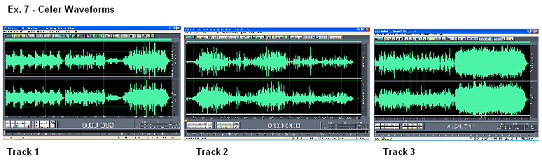
These are the waveforms of each track. The thicker and taller portions show a high amplitude, or loud volume. That big fat block at the very end is where the white noise and E Major kick in. They crash harder than any other moment on this album. There is a section with human voices having an argument that is as equally discordant as the aforementioned white noise.
The sounds and the music on the album create much dissonance together. The sounds are often irksome in tonal quality, and staccato in note duration, while the music is sweet and sustaining. The field recordings on this album are arranged in a kind of narrative, that walks around a wood and a beach, but it often feels out of place, the music never really jives with the sounds. I'd like to hear an unmixed version of this album with just the music and no sounds.
Overall, the music is simple. Just a few chords, a few keys, vibrating forever without tempo or time, bound only by a keynote. Melody exists only in the swelling between notes of a chord. Even without rhythm though, there could still be some significant movement somewhere - a real crescendo rather than just a long fade-in. The strongest movement occurs when an old chord fades, and a new chord enters. The different chordal sections are beautiful unto themselves, but their arrangement is wily-nily and cut-and-paste. They have no real continuity and are often indistinguishable. Also, the album could have been cut up into seven tracks based on the seven chords of the album.
Given the lack of musical variety, timbre has to pick up the slack, and this is the joy of listening to Close Proximity. The musical timbres on this album are all very engaging, and probably merit a listen through, just to hear something beautiful - the chords of love played on processed strings.
So if you need an album to meditate to, jam to, sleep to, or just enjoy listening to single chords and keys ebbing and flowing at a glacial pace, then this album is for you. Just beware of that white noise explosion near the end!